Dafinchi

Earnings call transcripts are one of the best places to understand what is happening inside a public company.
They show what management wants investors to know, what analysts are worried about, and how the company explains its performance, risks, and future outlook.
But if you are new to earnings calls, transcripts can feel overwhelming. They are long, packed with finance terms, and full of details that may or may not matter.
This guide gives you a simple way to read an earnings call transcript without getting lost.
You will learn:
What an earnings call transcript includes
Which sections to read first
What questions to ask while reading
How to spot important business signals
How to use Dafinchi Earnings Coach and Earnings Chat to move faster
This guide is for educational purposes only. It is not financial advice. Always do your own research before making investment decisions.
What Is an Earnings Call Transcript?
An earnings call transcript is a written record of a company's quarterly earnings call.
Most earnings calls have two main parts:
Prepared remarks
Management explains the quarter. This usually includes revenue, profit, margins, business highlights, risks, and guidance.
Analyst Q&A
Analysts ask questions. This section often reveals the real pressure points: demand, pricing, margins, competition, guidance, costs, inventory, customer behavior, or macroeconomic concerns.
A beginner mistake is to read the transcript from top to bottom without a plan.
A better approach is to read it like a set of questions:
What changed this quarter?
Why did it change?
What is management confident about?
What is management worried about?
What are analysts challenging?
Is the company story getting better, worse, or just more complicated?
Step 1: Start With the Company and Quarter
Before reading the transcript, make sure you know the basics:
Which company is this?
Which quarter and year is this?
What does the company do?
What industry is it in?
Was this a strong, weak, or mixed quarter?
Is the company growing, restructuring, defending margins, or navigating a tough market?
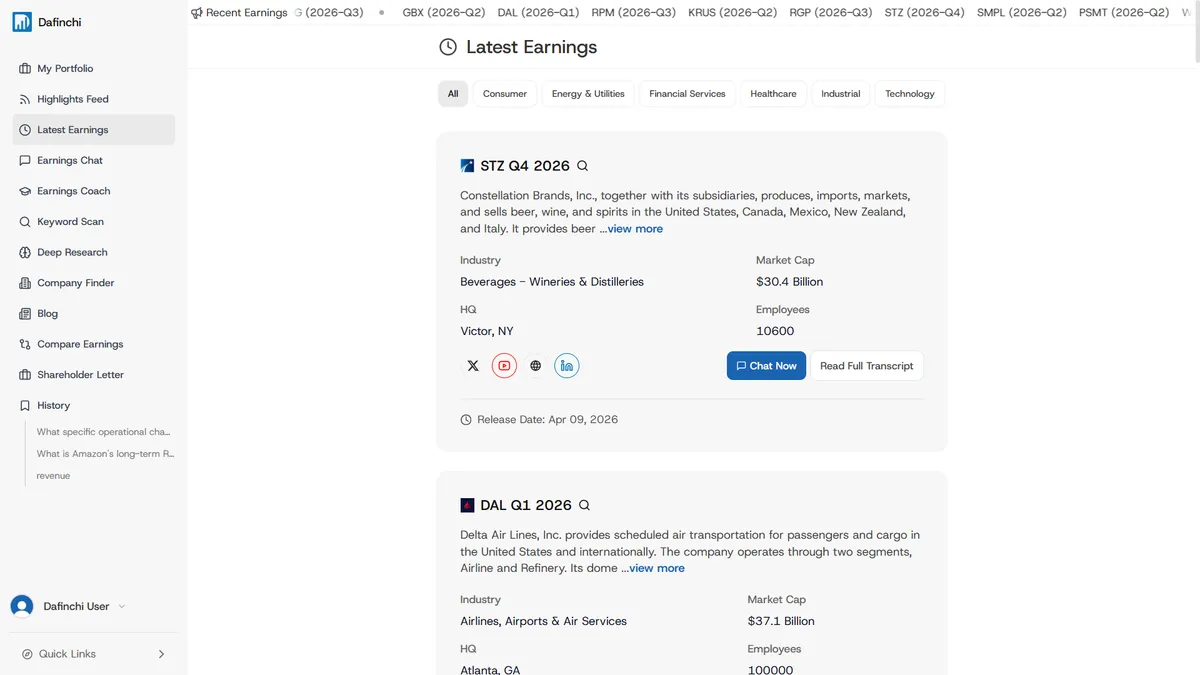
On Dafinchi, you can start from Latest Earnings or Company Finder to locate the company and the specific reporting period you want to read.

Step 2: Read the Summary Before the Full Transcript
Do not start by reading every word.
Start with the summary sections first. Your goal is to build a quick mental map of the quarter.
Look for:
Revenue growth or decline
Margin expansion or margin pressure
Profitability changes
Guidance changes
Major risks
New product or market commentary
Important customer or demand trends
Any surprises in the quarter
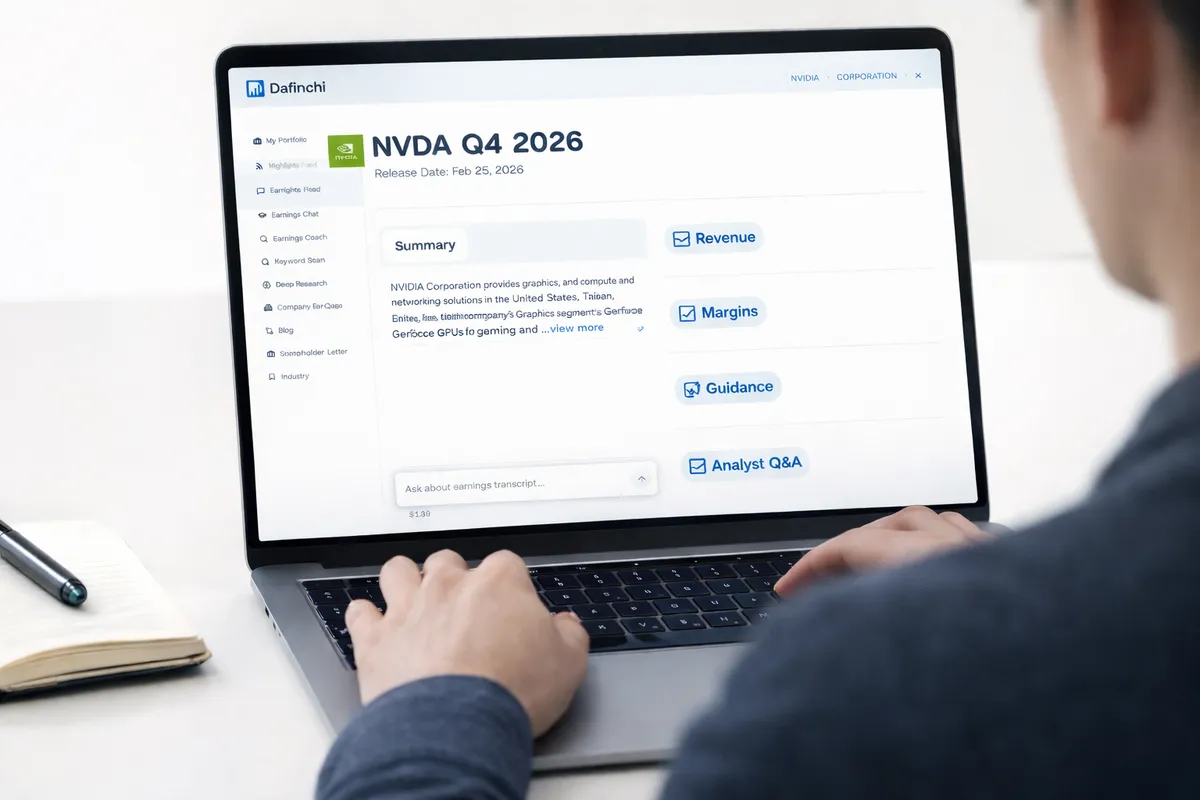
On a Dafinchi earnings transcript page, you may see sections like:
Financial Metrics Summary
Top surprises
Impact quotes
Notable topics discussed
Earnings summaries
Full earnings transcript
Suggested questions
Use these sections to understand the shape of the quarter before going deep.
A good beginner question at this stage is:
What were the three most important things that happened this quarter?
You can ask this directly from the textbox at the bottom of screen in earnings transcript page or in Earnings Chat after selecting the company and reporting period.
Step 3: Focus on Revenue, Margins, and Guidance
Most earnings calls can be understood through three big areas:
Revenue
Revenue tells you how much the company sold.
Ask:
Did revenue grow or decline?
What drove the change?
Was growth broad-based or limited to one segment?
Was growth driven by volume, pricing, acquisitions, or currency effects?
Did management mention demand strength or demand weakness?
Suggested Earnings Chat prompts:
What were the main drivers of revenue growth this quarter?
Did management say revenue growth was driven by pricing, volume, or demand?
Margins
Margins tell you how efficiently the company turns revenue into profit.
Ask:
Did gross margin or operating margin improve?
Did costs increase?
Did management mention pricing power?
Were there one-time expenses?
Is margin pressure temporary or structural?
Suggested Earnings Chat prompts:
What did management say about margin pressure?
Did the company explain whether margin changes are temporary or long term?
Guidance
Guidance tells you what management expects next.
Ask:
Did management raise, lower, or maintain guidance?
What assumptions are behind the guidance?
What risks could affect the outlook?
Did analysts push back on the guidance?
Suggested Earnings Chat prompts:
Was guidance raised, lowered, or reaffirmed?
What assumptions did management give for the next quarter or full year?
Step 4: Use Earnings Coach When You Do Not Know What to Ask
One of the hardest parts for beginners is not reading the transcript. It is knowing what questions to ask.
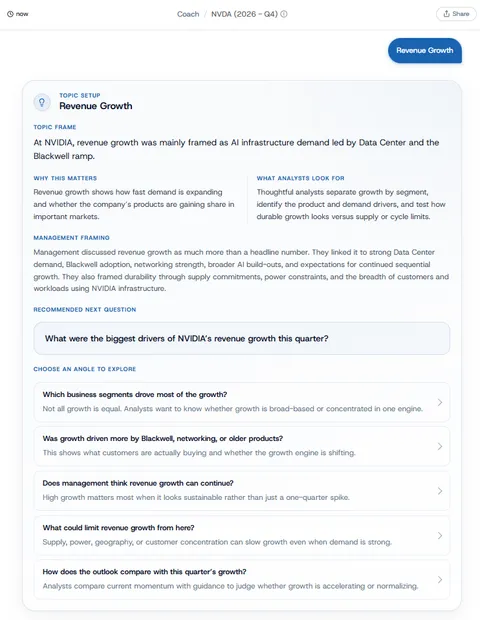
This is where Earnings Coach is useful.
Instead of starting with a perfect question, you can start with a topic like:
Revenue Growth
Margin Trends
Forward Guidance
Competitive Dynamics
Pricing
Demand
Costs
AI spending
Customer behavior
Earnings Coach helps turn a broad topic into sharper analytical angles.
For example, if you enter Margin Trends
Earnings Coach can help you explore questions like:
What changed in margins this quarter?
Did management explain the drivers of margin pressure?
Are cost issues improving or getting worse?
Did analysts challenge the company's margin outlook?
What follow-up question should I ask next?

Step 5: Read the Analyst Q&A Carefully
The analyst Q&A section is often the most valuable part of the transcript.
Prepared remarks tell you the company's story. Analyst questions test that story.
When reading the Q&A section, look for:
Questions that multiple analysts ask in different ways
Questions management answers vaguely
Questions about future risk
Questions about demand, competition, pricing, or margins
Questions about guidance assumptions
Follow-up questions that suggest the first answer was incomplete
Suggested Earnings Chat prompts:
What were analysts most concerned about in the Q&A section?
Which analyst questions did management answer most directly?
Were there any questions management seemed to avoid or answer vaguely?
What follow-up questions would you ask after reading the analyst Q&A?
Step 6: Separate Facts From Narrative
Every earnings call has facts and narrative.
Facts are the measurable items:
Revenue
Margins
EPS
Cash flow
Segment performance
Guidance
Customer growth
Costs
Capital expenditures
Narrative is how management explains those facts:
"Demand remains resilient"
"We are seeing temporary pressure"
"Customers are cautious"
"We expect improvement in the second half"
"Our investments are positioning us for long-term growth"
Both matter.
A beginner should ask:
Do the numbers support the story?
Is management explaining a real trend or just smoothing over a weak quarter?
Are analysts accepting the story or challenging it?
Has this same explanation appeared in previous quarters?
Do not treat confident language as proof. Look for numbers, repeated themes, and analyst follow-ups.
Step 7: Look for Repeated Themes
One transcript is useful. Multiple transcripts are better.
If management keeps mentioning the same topic across quarters, that topic may be important.
Examples:
Pricing pressure
Weak consumer demand
AI investment
Supply chain improvement
Inventory normalization
Cost reduction
International growth
Enterprise sales cycles
Regulatory risk
Competition
Dafinchi tools can help depending on the question:
Use Earnings Chat for one company and one transcript.
Use Earnings Coach when you want guided questions for one company and period.
Use Compare Earnings when you want to compare companies side by side.
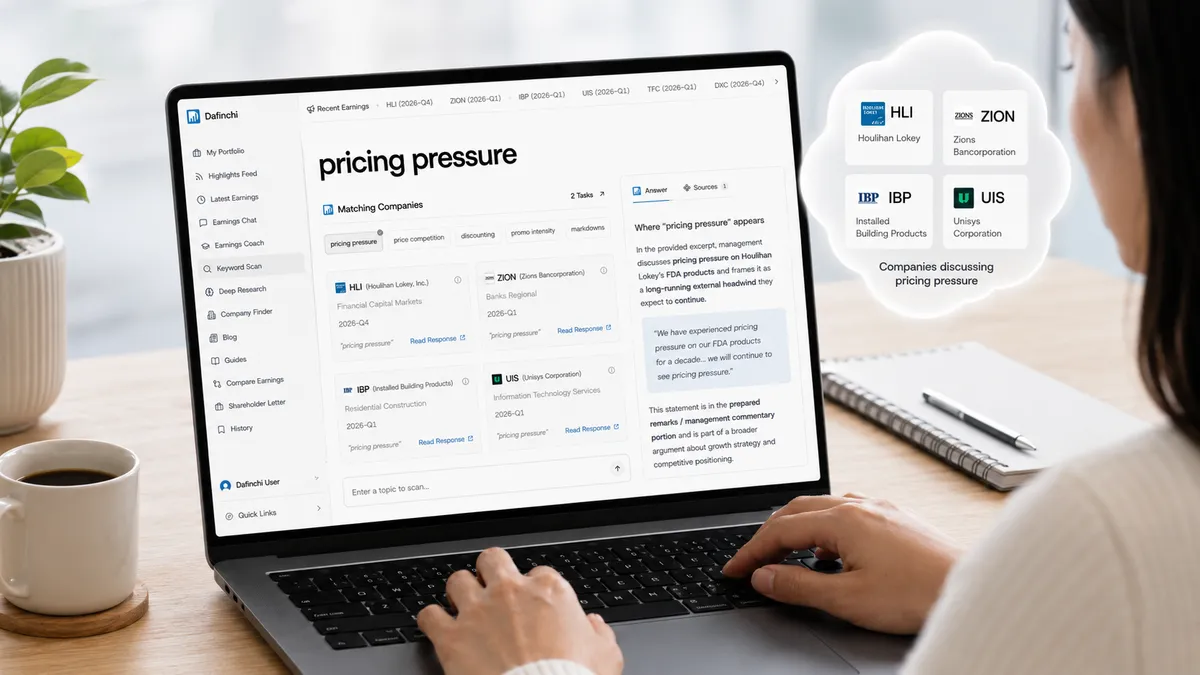
Use Keyword Scan when you want to find companies discussing a specific topic.
Use Deep Research when you want to explore broader market-wide patterns across earnings calls.
A Simple Beginner Checklist
Use this checklist every time you read an earnings call transcript.
What changed this quarter?
What caused the change?
What did management say about revenue?
What did management say about margins?
Did guidance improve, weaken, or stay the same?
What risks came up repeatedly?
What did analysts challenge in Q&A?
Did management answer clearly?
What topic should I compare with prior quarters?
What follow-up question should I ask next?
Example Workflow in Dafinchi
Here is a simple workflow for beginners:
Open Latest Earnings and choose a company transcript.
Skim the Financial Metrics Summary and Notable Topics Discussed.
Open Earnings Coach for the same company and period.
Start with a topic like Revenue Growth, Margin Trends, or Forward Guidance.
Use the guided questions to understand what matters.
Use Earnings Chat to ask specific follow-up questions.
Read the analyst Q&A section for pressure points.
Use Compare Earnings or Keyword Scan if you want broader context.
Common Beginner Mistakes
Mistake 1: Reading the whole transcript without a question
A transcript is easier to understand when you read it with a goal.
Example: What is the main business issue this quarter?
Mistake 2: Only reading prepared remarks
Prepared remarks are important, but they are controlled by management.
The Q&A section often shows what analysts are actually worried about.
Example: What did analysts challenge in the Q&A section?
Mistake 3: Ignoring guidance
A company can report a strong quarter and still guide cautiously.
Example: What did management say about future expectations and risks?
Mistake 4: Confusing one-time issues with long-term problems
Some problems are temporary. Others are signs of a deeper trend.
Example: Did management describe this issue as temporary, cyclical, or structural?
Mistake 5: Not comparing with prior quarters
A single transcript gives you a snapshot. Prior transcripts show the trend.
Example: Has management discussed this issue in previous earnings calls?
Final Thoughts
You do not need to understand every line of an earnings call transcript to get value from it.
Start with the basics:
What changed?
Why did it change?
What does management expect next?
What are analysts worried about?
What should I ask next?
For beginners, the best way to read a transcript is not line by line. It is question by question.
Dafinchi can help with that workflow. Use Earnings Coach when you need guided analytical angles, and use Earnings Chat when you already know the question you want answered.
Start with one company, one quarter, and one topic.