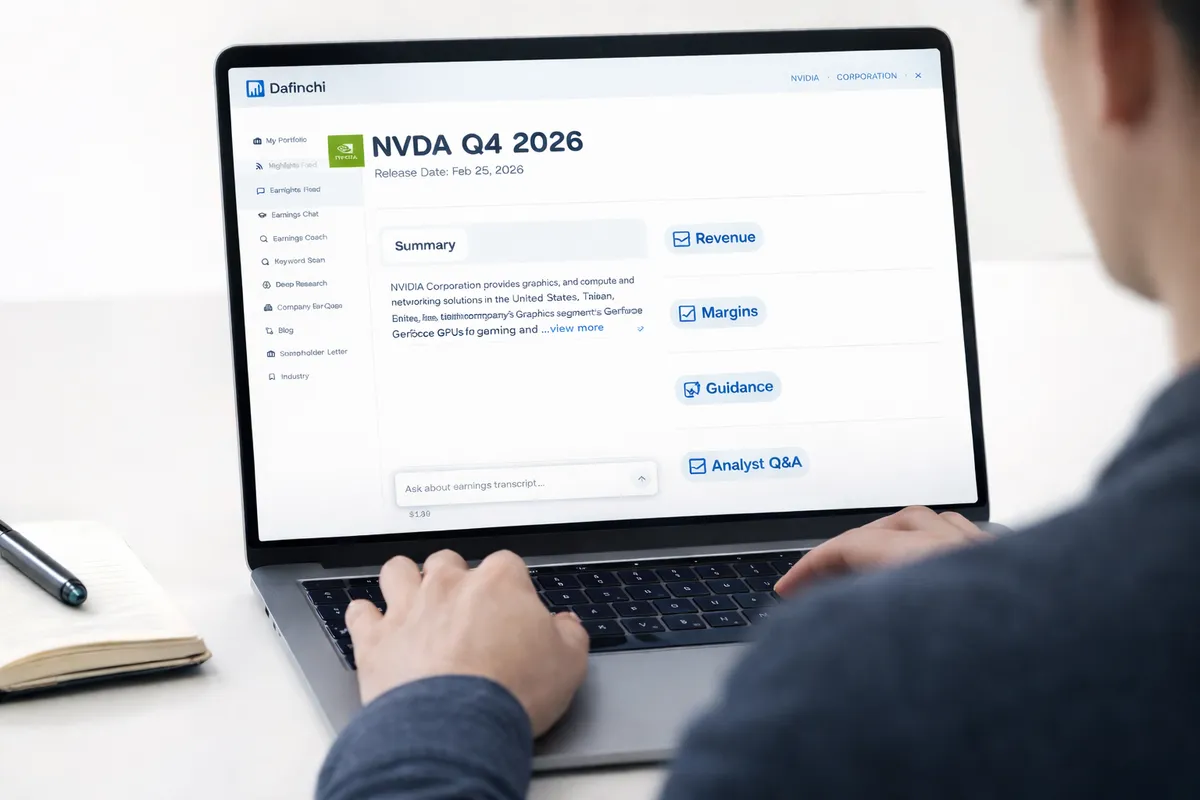
Dafinchi
Analyze Companies You Actually Care About
Most investment research starts with a ticker, a search box, and a single document.
That works when you already know exactly what you want.
But that is not how most real research happens.
Most people follow a set of companies over time. They care about their holdings, their watchlist, a few competitors, and the names they keep coming back to every quarter. They are not trying to analyze one company in isolation every single time. They are trying to understand a group of businesses that matter to them.
That is the idea behind My Portfolio in Dafinchi.
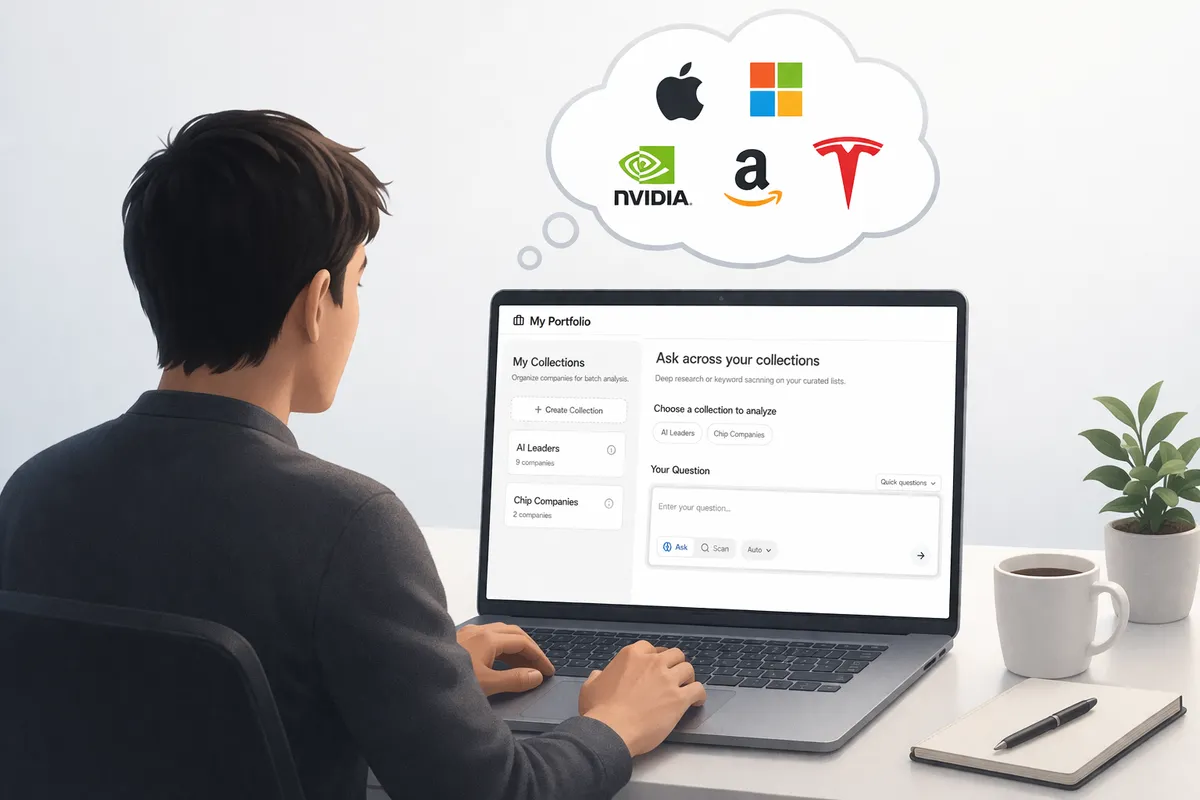
Instead of starting from scratch on every query, My Portfolio gives you a way to organize the companies you actually care about and analyze them together.
Research should start with your companies, not a blank page
Traditional transcript research can feel repetitive.
You search one ticker. Open one transcript. Ask one question. Then do it all again for the next company. After a few searches, you are left trying to connect everything in your head.
That approach breaks down quickly if you actively follow multiple businesses.
Because the real questions are usually not single-company questions. They are questions like:
Which companies in my portfolio are talking most about AI right now?
Which management teams sound more confident this quarter?
Where are margins improving, and where are they under pressure?
Which companies are becoming more cautious on demand, spending, or guidance?
What themes are repeating across multiple earnings calls?
Those are portfolio-level questions.
And portfolio-level questions need a portfolio-level workflow.
What My Portfolio changes
My Portfolio turns Dafinchi from a place where you look up companies one by one into a place where you can build your own research set.
You create a portfolio around the businesses you follow. That might be your real holdings, a thematic watchlist, a sector basket, or a comparison group.
Once that set exists, your workflow changes.
You are no longer asking:
Which company should I search right now?
You are asking:
What do I want to understand across the companies I follow?
That is a much more natural way to analyze earnings.
A better way to monitor recurring themes
Good investors and analysts do not just look for isolated facts. They track recurring themes over time.
They notice when companies start using new language. They catch when a topic becomes more important. They compare how management teams frame similar pressures.
My Portfolio is designed for exactly that kind of work.
Instead of jumping across separate transcript pages, you can use your portfolio as the base for structured analysis. You can look for patterns across your companies and spend less time rebuilding context.
That makes it easier to monitor themes such as:
AI investment and monetization
pricing power
consumer weakness or enterprise resilience
guidance changes
margin expansion or compression
supply chain commentary
capital allocation priorities
competitive positioning
The value is not just finding mentions. It is understanding how those themes show up across the companies that matter to you.
From saved list to active research tool
A watchlist is passive.
A real portfolio research workflow should be active.
That means helping you do more than save names.
It should help you ask better questions, compare signals, and surface what matters across a set of companies.
That is where My Portfolio becomes powerful inside Dafinchi.
Because Dafinchi is built around earnings transcripts and company research, the portfolio is not just a folder. It becomes a starting point for deeper workflows.
You can imagine using it to:
run research across a custom group of companies
scan for keywords or themes across your portfolio
compare how multiple management teams discuss the same topic
track shifts in tone or focus over time
stay close to the companies you follow without manually checking each one
In other words, My Portfolio helps move research from fragmented searching to intentional monitoring.
Why this matters for actual users
Most people do not care about the entire market equally.
They care about a subset.
That subset is where they spend their attention, where they make decisions, and where they need better tools.
For an investor, that might be a portfolio of current holdings.
For a student, it might be a hand-picked set of companies in an industry they are trying to understand.
For an operator or founder, it might be competitors and adjacent businesses.
For someone exploring a new sector, it might be a curated basket of names worth learning.
In every case, the job is the same: turn a list of relevant companies into a research workflow that is easier to repeat.
That is the gap My Portfolio is designed to fill.
The real benefit: less setup, more thinking
A lot of research friction comes from setup.
Finding the company. Opening the right transcript. Repeating the same process. Recreating the same comparison set in your head every time.
That is low-value effort.
The higher-value work is in the thinking:
identifying what changed
spotting what is new
comparing management language
detecting patterns early
deciding which signals matter most
My Portfolio helps reduce the setup work so you can spend more time on that higher-value layer.
Built for how earnings research actually works
Earnings analysis is rarely a one-off activity.
It is continuous.
You follow the same businesses quarter after quarter. You compare them against each other. You revisit the same themes and notice what changes.
A product built for that workflow should reflect that reality.
That is why My Portfolio matters.
It gives Dafinchi users a way to organize research around relevance, not just searchability.
And that leads to a better experience:
fewer repetitive steps
more consistent tracking
easier cross-company analysis
a more personal research workflow
Analyze the companies that matter to you
The best research workflows are not built around endless searching.
They are built around focus.
My Portfolio in Dafinchi is about giving that focus a home.
So instead of starting from scratch every time, you can start with the companies you actually care about and analyze them in a way that matches how real research works.
Because better research starts when your tools remember what matters to you.
Try my portfolio now on dafinchi.